


Most companies overthink their LinkedIn ABM strategy. I’ve been running an Account Based Marketing program since 2024 (you can ready the story about how it started here), made a lot of mistakes – but also hopefully learned a few lessons about LinkedIn ABM strategy (first hand + by reading a ton of content and getting advice from these LinkedIn ads experts – give them a follow too, I’m including a lot of the learnings I took from their posts below!) – which I will share with you below in the most actionable way I can – together with easy to implement campaign templates & tools you will need.

Before we dive deep, here’s the quick overview of the 8 steps you’ll need to build a winning LinkedIn ABM strategy:
Let’s break down each step with the actual LinkedIn ABM strategy playbook I use.
Here’s where most teams go wrong: they start with a completely cold list of companies that “fit their ICP” and wonder why ABM isn’t working. Don’t start cold. The best LinkedIn ABM target account lists start from low-hanging fruits – accounts that already have some relationship with your brand:
Only after you’ve exhausted these warm sources should you go after completely cold accounts from your ICP.
Clay is the secret weapon for ABM list building. It allow you to build your target account lists by:
Here’s how the experts use it – read more insights in this deep dive with Clay experts.

Don’t overthink campaign structure. Keep it simple: one ABM campaign per persona/ICP segment. If you’re targeting different personas with different pain points (e.g., “Marketing Leaders” vs “Sales Leaders” vs “RevOps”), each gets their own campaign.
Now, there’s also another aspect you need to consider before structuring your ABM campaigns around personas, and ABM campaign stages – your audience size. Since the minimum audience size to run ads on LinkedIn is 300 members (and the smaller the audience, the more expensive your ads – as the CPMs (cost per 1000 impressions) goes up when you target more “niche” audiences!)
So in practice – split your LinkedIn ABM campaigns into:
…but leave the more granular ABM stages for the sake of a) understanding and tracking how your campaigns are going; b) passing the “interested” accounts to your BDR team/ pushing them into automated outreach.

Based on our LinkedIn ABM Benchmarks Report 2026, here’s the optimal ad mix:
| Ad Format | Quantity | Why |
|---|---|---|
| Thought Leader Ads (TLAs) | 5 ads | Best value: 77% cheaper CPC ($3.06 vs $13.23), 2.68% CTR |
| Single Image Ads | 5 ads | Good reach, reliable performers |
| Carousel Ads | 1 ad | Balanced engagement, good for explaining complex products |
| Video Ads | 2-3 ads | Awareness building (keep spend low – video underperforms on CTR) |
| Text Ads | 5 ads | Cheap impressions, brand reinforcement |
This gives you ~15-19 ads per persona, covering all the relevant jobs to be done. This is based on the findings our LinkedIn ABM Benchmarks Report 2026 from 211 ZenABM users and over 160k ads!
I based the Linkedin ad inventory matrix on the lowest cost per click and the highest engagement rate:

The biggest mistakes I see companies make when starting their ABM campaigns is that they are just pulling their ABM budget out of their…thin air 😉 No revenue targets, no pipeline goals, no calculations based on their CMPs or CPCs and number of target accounts they need to reach…no wonder their first LinkedIn ABM campaigns often flop – they simply launch too many ads with too little budget, or target too few personas – to see any meaningful results.
To set a realistic ABM budget, we first defined a clear revenue goal and then worked backwards using ACV, close rate, and qualification rate to calculate how many target accounts we needed to reach. Using historical LinkedIn benchmarks such as CTR, CPC, and CPM, or industry benchmarks, you can then estimate the budget required to reach enough of those accounts.

This is what we did: Using Kyle’s ABX benchmarks, we set a revenue target and ACV, then reverse-engineered the funnel. For example, to close $1M in ABM revenue with a $50k ACV, 25% close rate, and 75% qualification rate, we needed 3,367 accounts in our target audience.
$1,000,000 ARR ÷ $50k ACV = 20 deals. 20 ÷ 0.25 ÷ 0.75 ÷ 0.18 ÷ 0.32 ÷ 0.55 = 3,367 target accounts.
Assuming typical stage conversion rates, this meant generating ~107 demos. With a $1,100 cost per conversion, the estimated LinkedIn ad budget was ~$118k, or ~$147k when calculated more precisely using CPMs, CTRs, and landing page conversion rates.
With average CTRs of 0.35–0.45%, you get only 3–4 clicks per 1,000 impressions. At a 1% landing page conversion rate, generating 107 demos requires ~2.67M impressions. At a $55 CPM, that equals $147,125 in ad spend, plus a 15–20% buffer for margin of error.
Now this is important: you must decide on how to allocate your LinkedIn ABM budget to different LinkedIn Campaigns (Image, TLAs, Videos etc.) in a reasonable way (I’m explaining the math below!) before launch to avoid budget dilution. We learned the hard way that campaigns fail when each ad gets too little spend to generate meaningful data.
I really liked how no-nonsense this post by Ali Yildrim from Understory explained it:

Without doing this, you can fall into a trap we have fallen into multiple times – spreading your small LinkedIn ads budget so thinly across too many ads, with high cost per click, so you can’t see any meaningful data or results from your campaigns at all (because you simply can’t afford to serve them!). Here’s an example of such campaign:


The key insight is simple: divide your monthly budget by 30 to get your real daily limit. That number determines how many ads you can realistically run and how many personas or intents you can support.
Let’s take this example:

How much would it cost you to run the campaign from the above template for just one persona or intent? Let’s do the maths:
$14,630 per month. So for example with a $10k monthly budget, you cannot run a full campaign mix, so focus on fewer formats or one persona or intent at a time.
Following this math ensures each ad gets enough spend to learn, each campaign produces intent signals quickly, and optimization decisions are based on real data, not noise.
Divide that number by the ads required per campaign format to see how many campaigns you can realistically afford.
Goal: You need at least 3 clicks/engagements per ad per day to get meaningful performance data. Calculation:
If your budget is lower, reduce the number of ads but maintain the minimum clicks per ad. Better to run 8 ads well than 15 ads with no data.


This is where most ABM programs fail: generic, corporate ads that look like every other B2B company’s feed. Let me share what actually works based on our analysis of 10,000+ LinkedIn ads. For detailed benchmarks and best practices for what top performing ads contained visually, check our full LinkedIn ABM Benchmarks Report 2026.


TLAs are the best performing ad format by far:

| What Works | What Doesn’t |
|---|---|
| 1st person “I” voice (65% of top performers) | Corporate “we” voice |
| Link placement at bottom (75% position link in final 25%) | Link interruptions mid-content |
| 1,000-1,500 characters optimal length | Too short or too long |
| Pain-point hooks: “I’ve seen so many…” | Generic opening statements |
| FREE trials or ungated resources | Webinar CTAs (0% in top 20!) |
Based on our analysis of extremely high CTR ads (2%+): 


Carousels work well for:
Keep each card focused on one idea. End with a strong CTA card. 

Honest truth: Video underperforms on CTR (0.24% vs 0.42% for image). But it’s useful for:
Keep video spend to 5-8% of budget. Don’t over-invest here.
Cheap impressions for brand reinforcement. Use them alongside your main ad formats for maximum touchpoints.
You’ve built your lists, planned your campaigns, created your ads. Now don’t blow it at launch.
Use the Classic Ad Editor. The new Accelerate features give you less control over targeting and bidding. For ABM, you need precision.
Use “Website Visits” objective. Not “Brand Awareness”, not “Engagement”, not “Lead Generation” (unless you’re using Lead Gen Forms, which I don’t recommend for ABM). Website Visits lets you:
Turn OFF audience expansion. For ABM, you want to hit your specific target accounts, not LinkedIn’s “similar audiences.”
LinkedIn will happily show your ads 50+ times to the same person. Set frequency caps to avoid annoying your prospects and wasting budget.
According to Ali Yildirim from Understory: “One of the frequent issues we see when reviewing LinkedIn ad accounts is the consolidation of spend and impressions on top accounts, usually the ones with more employees. We have a workaround to make sure that the smaller accounts still receive an equal proportion of spend.”
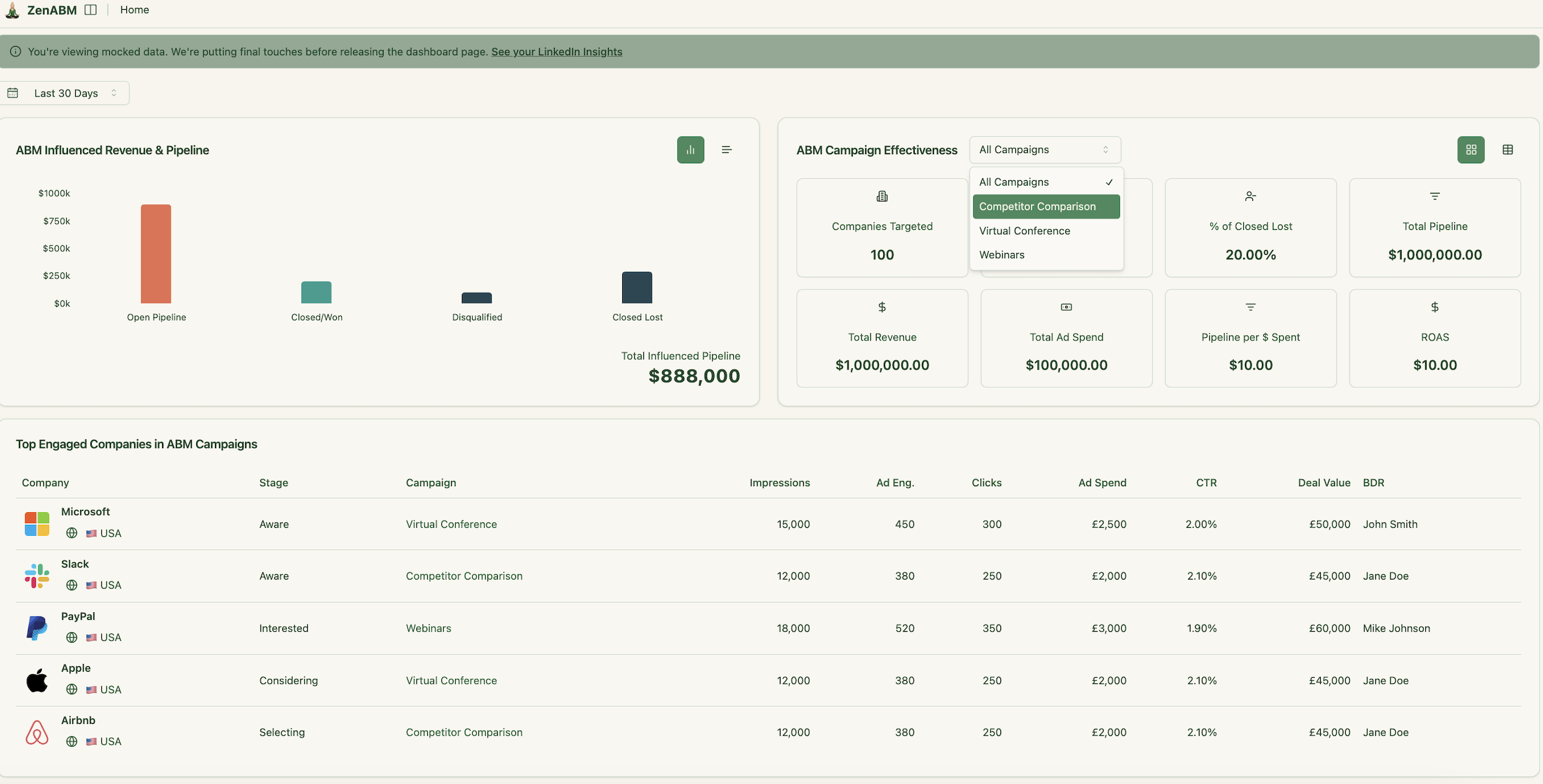
This is where ABM gets real. You’re not measuring clicks and impressions – you’re measuring account progression through buying stages.
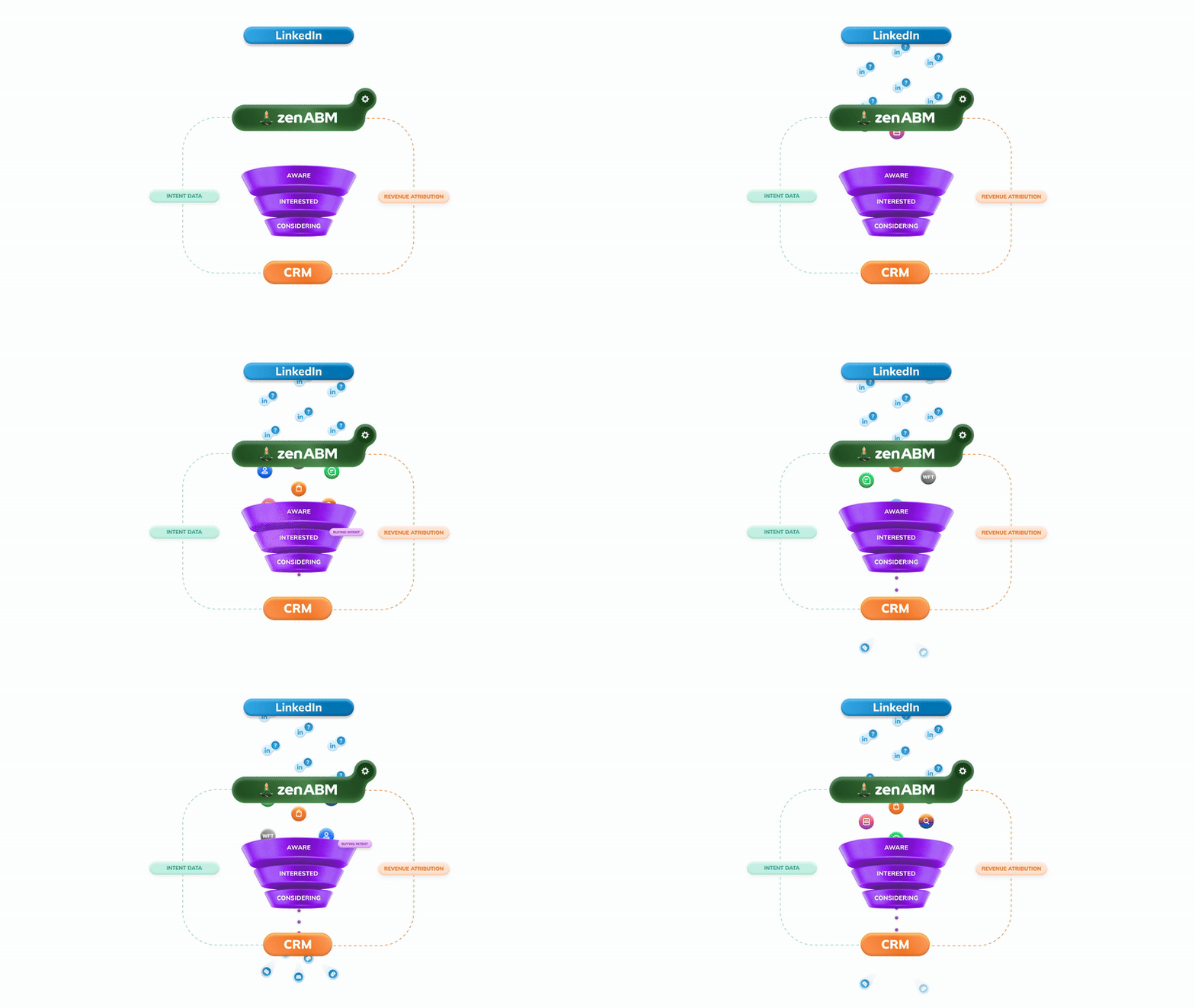
ZenABM uses a 5-stage framework aligned with the awareness funnel:
| Stage | Definition | Typical Conversion % |
|---|---|---|
| 1. Identified | All targeted accounts (your TAL) | 100% |
| 2. Aware | 50+ ad impressions | ~55% |
| 3. Interested/Engaged | 5+ clicks or 10+ engagements | ~32% |
| 4. Considering | Demo bookings, trial signups | ~18% |
| 5. Selecting | Accounts with open deals | Varies |
These benchmarks come from Kyle Poyar’s ABX framework, which I used to design our account scoring and stage thresholds – and to design the “ABM stages” feature in ZenABM that scores all your accounts automatically:

In 2026, ZenABM removes the biggest bottleneck in LinkedIn ABM – turning ad engagement into something you can actually act on. It deanonymizes LinkedIn ad engagements at the company level, automatically scores and stages accounts based on real engagement thresholds, and pushes both quantitative and qualitative signals into your CRM without brittle workarounds. Instead of guessing who is “warm,” teams can see which accounts are aware, interested, or considering, trigger the right follow-up ads or outbound at the right moment, and measure pipeline per dollar spent rather than vanity metrics. In practice, ZenABM turns LinkedIn ABM from a reporting exercise into a repeatable revenue system that scales with higher ACVs and more complex buying committees.
Forget vanity metrics. Here’s what actually matters for LinkedIn ABM.
Traditional lead gen measures MQLs. ABM measures influenced pipeline – the total value of deals where your target accounts engaged with your LinkedIn ads before entering the sales process. This is a fundamental mindset shift:

| Metric | Definition | Benchmark (Top 25%) |
|---|---|---|
| Pipeline per $ Spent | Total influenced pipeline / ad spend | $15.20 per $1 (median: $5.21) |
| Deal Open Rate | % of engaged accounts that opened deals | Varies by ACV |
| ABM Stage Progression Rate | % moving from Aware → Interested → Considering | See framework above |
| Account Coverage | % of target accounts reached with 50+ impressions | >55% |
| De-duplicated Revenue Attribution | Revenue attributed without double-counting across campaigns | Use ZenABM |
Not all personas convert equally. Track pipeline per $ spent by persona to know where to allocate budget:
ZenABM gives you these dashboards out of the box, with ABM campaign objects that group your LinkedIn campaigns by initiative for proper attribution.
Here’s where ABM turns into pipeline. Accounts in your “Interested” stage (5+ clicks, 10+ engagements) are showing buying signals. They’re warm. Don’t let them go cold. This is the core of intent-based outbound – using intent signals to trigger personalized outreach instead of cold blasting.
Ads should never exist in a silo. As Ali Yildrim put it in one of his posts: “It’s our duty as good advertisers to make sure every dollar matters.” Using ZenABM’s webhooks, you can import all of the companies engaging with your ads into Clay. Then we basically copy and paste the job titles we’re targeting on LinkedIn and use a Find People lookup function in Clay to find the LinkedIn profile URLs of the relevant titles at those companies.
Pro tip: Export your CRM’s closed-lost deals from the past 18 months. Upload to Clay. Enrich with current company signals (funding, hiring, tech stack changes). Score. You now have a warm ABM list that’s infinitely more likely to convert than a cold ICP list.


Don’t pitch slap. Even though they’re engaging with your ads, they haven’t raised their hand. The goal is to start a conversation, not close a deal.
Expert Insight from Alex Fine (Understory): “I’m generating one opportunity for Understory for every 44 people I reach out to via cold email. That is elite efficiency. Every contact runs through ICP screening at both the contact and company level automatically in Clay. The messaging is funny, but also very specific to how they were found in the first place.”
Sample LinkedIn connection message:
“Hey [Name], noticed [Company] has been exploring [topic from ZenABM’s intent signals – based on the company’s ad engagement]. We work with a lot of [similar companies] on exactly this. Would love to connect and share what’s working for them if it’s useful.”
Sample email:
“Hi [Name], I saw [Company] has been researching [intent topic]. We recently helped [similar company] achieve [specific result]. Thought you might find this [relevant resource] useful. Worth a quick chat?”

ABM isn’t set-and-forget. Here’s how to continuously improve your campaigns:
This seems obvious, but most teams let underperforming ads run for months. Review weekly all the ads:
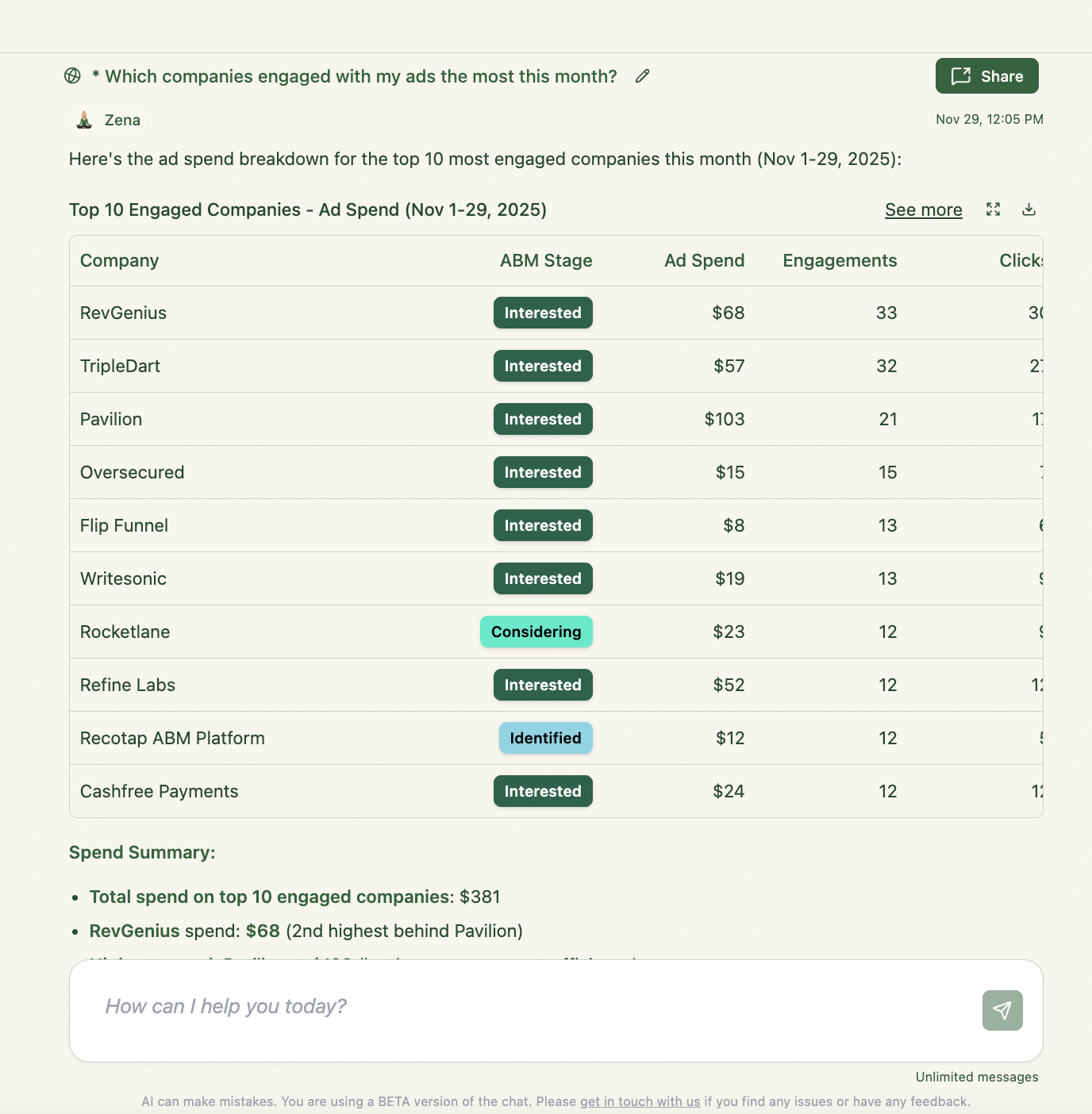
Not sure which ads are performing and which are not? Zena AI gives you instant answers from your LinkedIn ads API – without digging through tons of campaign manager reports!
Reallocate budget to your winners. Here are the average CTRs by ad format based on our review of over 160k ads from 211 companies that use ZenABM:
Ad fatigue is real on LinkedIn. Your target accounts will see the same ads repeatedly. Introduce 2-3 new creatives per month per campaign. What to test:
Review pipeline per $ monthly by:
Shift budget toward what’s working. Cut what isn’t.
As you see which account characteristics correlate with pipeline, use that to build lookalike lists:
We went from targeting 2,5k to 26k to finally – 47k companies with our LinkedIn ABM ad program.
Look, I know this post is long. But here’s the truth: LinkedIn ABM doesn’t have to be complicated. The simple version:
That’s it. Our first ABM campaign generated over $900K in pipeline with $8 pipeline per $1 spent. And we made plenty of mistakes along the way. The key is starting. You’ll learn more from running one ABM campaign than from reading 10 more blog posts about ABM strategy. 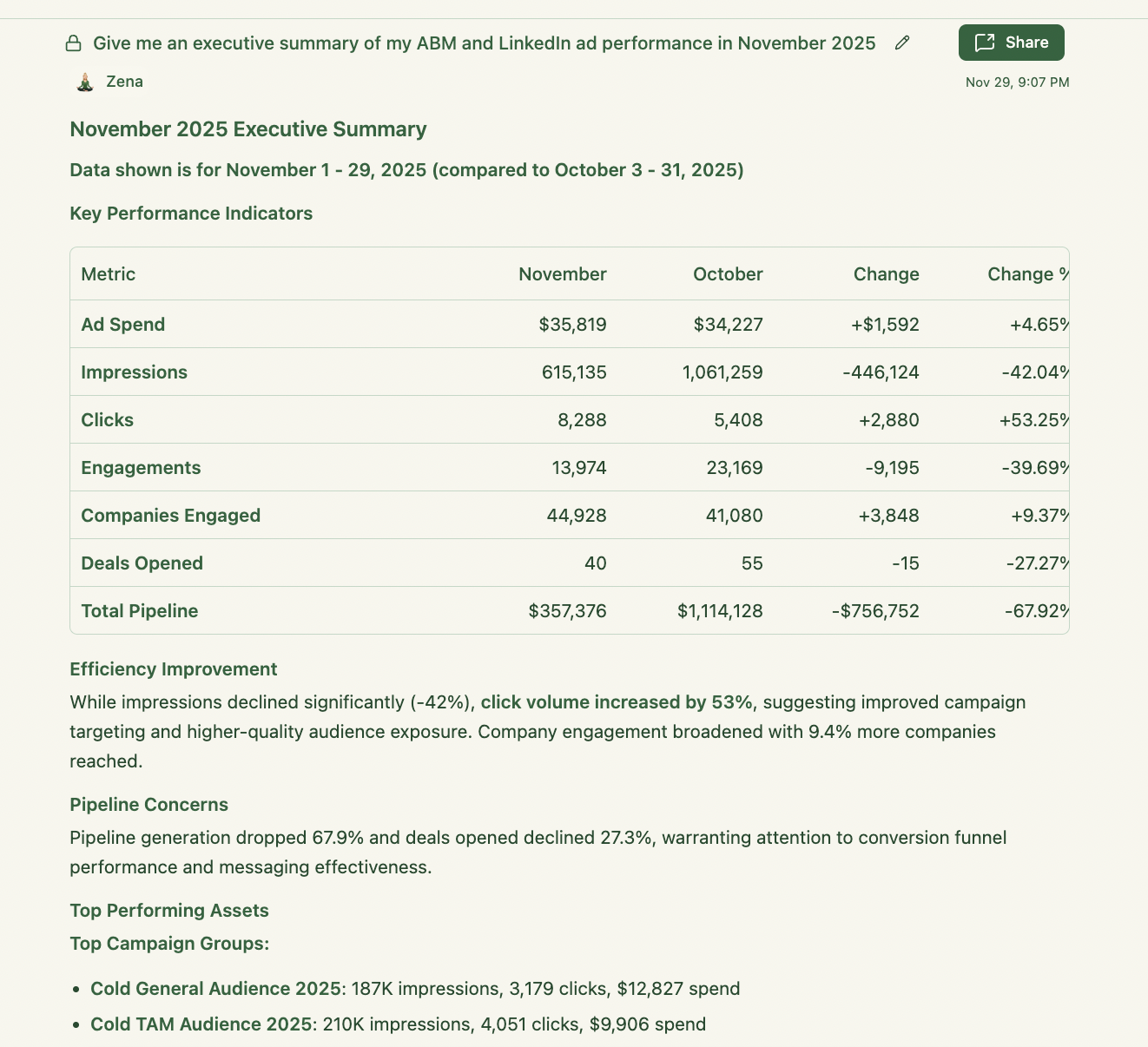
| Purpose | Tool | Why |
|---|---|---|
| ABM Analytics & Attribution | ZenABM | Account stages, scoring, intent, pipeline attribution, AI chatbot (Zena) |
| List Building & Enrichment | Clay | Data waterfall, account scoring, contact discovery |
| LinkedIn Outreach | HeyReach | Automated connection requests and follow-ups |
| Email Outreach | Instantly / Smartlead | Sequences for engaged accounts |
| CRM | HubSpot / Salesforce | Pipeline tracking, deal management |
I learned most of what I know from these people. Give them a follow:
Ready to stop guessing and start running ABM that actually generates pipeline? Start your free ZenABM trial and see which accounts are engaging with your LinkedIn ads today.
Minimum $10-15K/month per persona to get meaningful data (3+ clicks per ad per day). If your budget is lower, reduce the number of ads but maintain click volume per ad.
Expect 3-6 months to see pipeline impact. Month 1-2 is awareness building. Month 3+ is when accounts start progressing to demo/trial stage. Don’t judge ABM on 30-day results.
For ABM, drive to website. Lead Gen Forms capture contact info but don’t tell you account-level engagement. Use Website Visits objective for better ABM analytics.
Depends on budget and goals. Use the reverse-engineering formula: if you need 20 deals and have typical conversion rates, you need ~3,400 target accounts. Adjust based on your specific numbers.
Demand gen casts a wide net and optimizes for lead volume. ABM focuses on specific high-value accounts and optimizes for pipeline influence and account progression. ABM is about depth (engaging the right accounts deeply), demand gen is about breadth (reaching as many potential buyers as possible).
No. ZenABM starts at $59/month and gives you account stages, scoring, intent, and pipeline attribution. You don’t need $50K enterprise platforms to run effective LinkedIn ABM. Start lean, prove results, then evaluate if you need more.
