


In this article, I have dissected 7 pretty successful real-world B2B SaaS ABM campaign examples.
For each example, I have covered its unique tactics and the impressive outcomes achieved.
Read on and steal away the one that suits your B2B venture the most.
Snowflake (a cloud data platform) ran a famously tactile ABM campaign.
They combined personalized direct mail with rich digital content.
For this, they conducted in-depth research on 200 large accounts (e.g., Walmart, Kaiser, JPMC) and developed custom data visualisations and reports for each account’s specific needs, like retail analytics for Walmart, healthcare data insights for Kaiser, etc.
These bespoke packages (often delivered via premium iPads or printed booklets) demonstrated the ROI and solutions Snowflake could bring.
By blending high-touch physical mailers with online tracking, Snowflake reported 85% of packages opened and generated over $50 million in pipeline from just 200 accounts!.
In other words, each account touched was worth tens or hundreds of thousands in opportunity.
Key tactics and lessons here:
Map out each target’s challenges and KPIs to create truly custom collateral (charts, ROI calculators, case studies).
Use premium formats (e.g. tablets, printed booklets, branded swag) so the package stands out and feels valuable (ofc deal value must be higher to justify such expense).
Include QR codes or web links that let you track engagement with the content. For example, Snowflake’s mailers triggered a digital “welcome page” or demo sign-up, letting sales know when to follow up.
Prepare sales reps with account-specific briefs. Snowflake had marketing and SDR teams coordinate on follow-ups as soon as prospects interacted. It boosted conversions.
By combining handcrafted content with data-driven personalization, Snowflake’s ABM campaign drove exceptional engagement and pipeline.
Other B2B tech firms can adapt this model by scaling down the costs (e.g. less expensive packages) while keeping the personalization and tracking components.
Salesforce (CRM and cloud software) executed a targeted ABM campaign for the healthcare sector by using intent data.
They identified hospitals and health systems actively researching CRM solutions, then launched a mix of outreach: personalized email sequences, invite-only webinars for C-level health executives, and VIP content.
The campaigns were highly personalized with messaging that referenced each hospital’s specific needs (e.g. patient experience, compliance).
The results were impressive, too: Salesforce reported a 32% increase in pipeline from these healthcare accounts.
Steps and tactics from Salesforce’s playbook:
Use data platforms or third-party providers to spot which target companies are “in market” (downloading healthtech content, visiting EMR pages, etc.). You can also use a pilot ABM campaign with a mix of TOFU, MOFU, and BOFU content to see companies actively engaging with your ads, which indicates there being in-market. You can also diversify your ad content based on different features and offer to understand each account’s intent, i.e what feature/quality/offer of your product/service intrigues them the most.
You can do this using ZenABM.
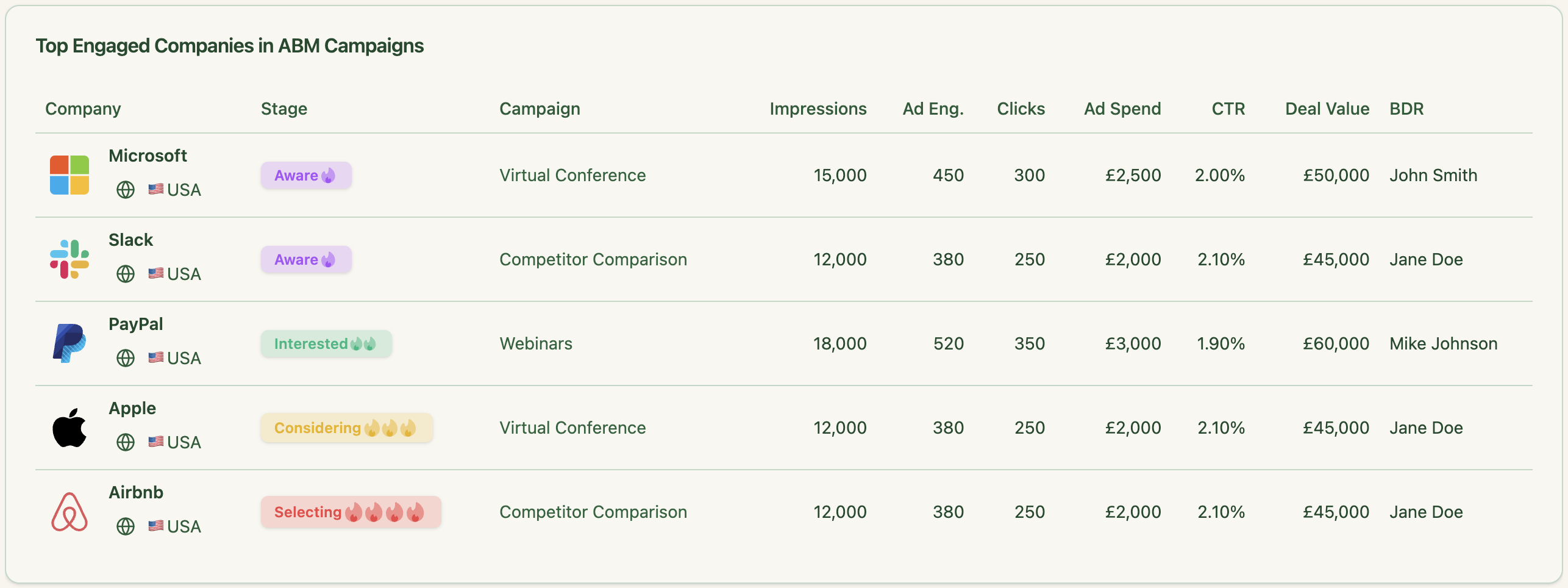
It tracks company-level impressions for each campaign and campaign group:
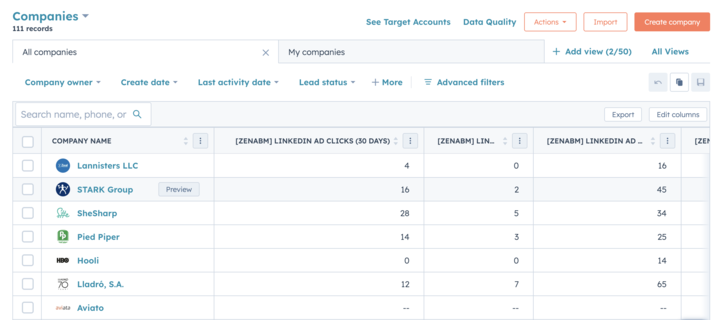
Then pushes the same data to your CRM so your sales team can access it conveniently:
And you can also tag each campaign with the intent (the feature/quality/offer being advertised by that ad creative), and then ZenABM will group engaged companies showing similar intent together:
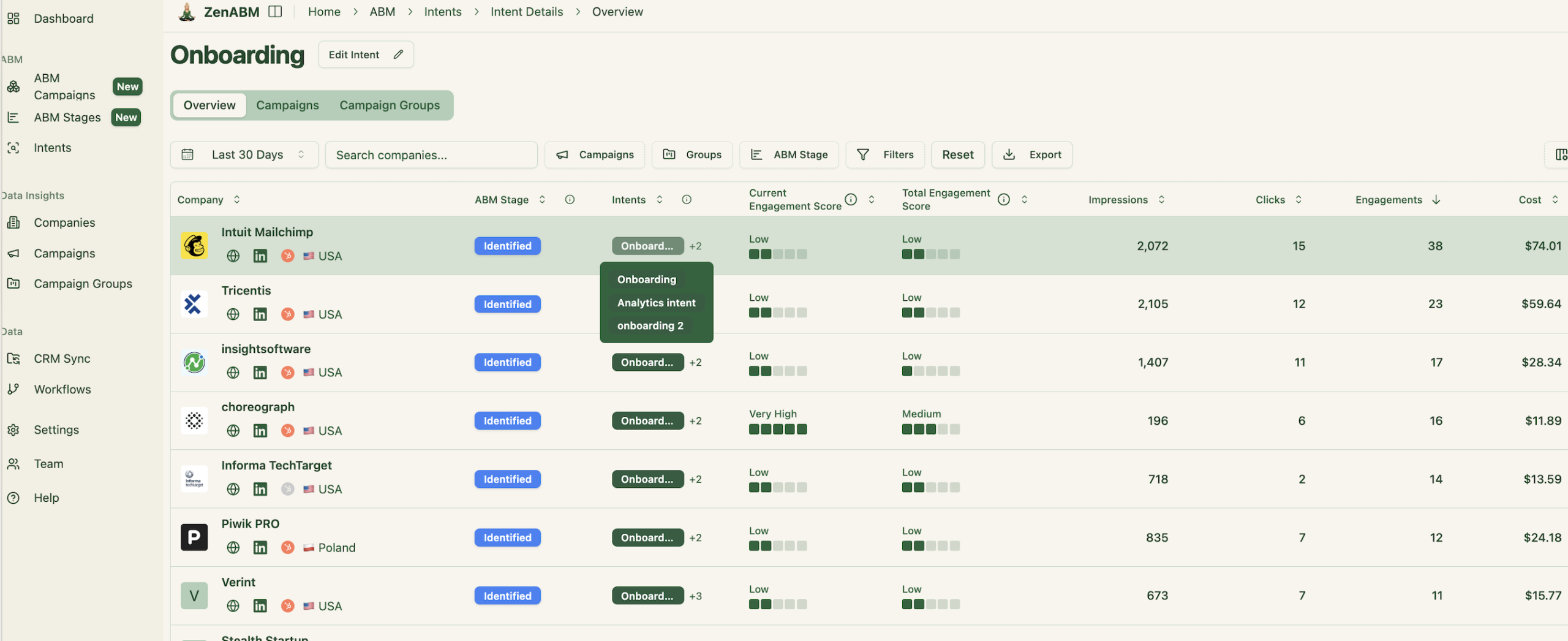
So, you’ll know companies that are in-marke for the exact solution you sell!
Send account-specific email campaigns. For example, they dse the hospital’s name in subject lines and link to case studies of similar healthcare clients.
Invite only key decision-makers to invite-only events or roundtables. Salesforce created bespoke webinar content (e.g. panels on healthcare tech trends) and pitched it as an exclusive executive briefing.
After each marketing touch, ensure the account’s sales team follows up quickly. Salesforce coordinated so that any engagement (webinar RSVP, whitepaper download) triggered a tailored sales call or meeting.
By aligning marketing with sales and concentrating on a vertical (healthcare), Salesforce turned specific accounts from cold prospects into warm leads. The key was using personalization at each stage — communications felt tailor-made for each hospital, driving that +32% pipeline growth.
Any SaaS company can replicate this by narrowing down on an industry, using intent data to pick targets, and layering channels (email, events, direct outreach).
Adobe shifted its approach from broad demand generation to true ABM when targeting large enterprises.
They focused on Fortune-500 accounts and employed AI/predictive analytics to inform every step.
Using real-time engagement data (web activity, content downloads, etc.), Adobe delivered account-level personalized communications.
For instance, if a CMO at a target bank was viewing retail-focused whitepapers, the next touch might be a tailored email highlighting Adobe’s retail analytics solutions.
This data-driven personalization led to dramatic results: Adobe saw a 60% increase in deal size and 40% higher customer retention in those accounts.
Key tactics in Adobe’s ABM campaign:
In sum, Adobe’s approach shows the power of data-driven personalization. By tailoring the buyer’s journey based on real behavior and infusing AI recommendations, the Adobe team significantly grew sales metrics.
The playbook takeaway: integrate predictive analytics and tailor every touch to the account’s context.
Engagio (now part of Demandbase) popularized “multi-channel account orchestration”.
Instead of treating channels separately, they created a unified campaign plan for each account, sequencing messages across email, LinkedIn, events, direct mail, and sales calls like a symphony.
For example, a target might get a LinkedIn message from an SDR, followed by a personalized email, then a piece of tailored direct mail, then an invitation to a small VIP event – all reinforcing the same core message.
What made Engagio’s ABM special:
The result of this orchestration was that Engagio saw 300% higher engagement and sped up deals by over 35% compared to non-ABM accounts.
Drift, a conversational marketing platform, used an innovative 1:1 ABM approach by deploying AI chatbots on its website to target specific accounts.
As soon as a visitor from a target company lands on their site, Drift’s system (via reverse-IP lookup) recognizes the company and immediately serves a custom greeting through a chatbot.
The message might mention the visitor’s company name and relevant pain points (e.g. “Hi [Name], we’ve helped other finance companies reduce risk by 30% – would you like to see how?”).
This instant personalization grabs attention.
The chatbot then engages in real-time qualifying dialogue and seamlessly hands qualified leads to sales reps.
Key elements of Drift’s ABM chatbot strategy:
This conversational ABM is particularly effective for SaaS companies selling to tech-savvy firms. It scales personalization without manual effort and instantly identifies warm prospects. The flipside: it requires a sophisticated setup and depends on accurate IP-to-company data.
Overall, Drift’s campaign highlights how AI chat can deliver high-touch ABM at scale, rapidly advancing target accounts through the funnel.
DocuSign (e-signature/SaaS) used a “1-to-many” ABM by building industry-specific content hubs and on-site experiences.
They identified six key verticals (e.g. legal, finance, healthcare, manufacturing) and created dedicated content pathways for each.
When a visitor from a target industry arrived on DocuSign’s site, they would see tailored case studies, testimonials, and resources relevant to their sector. For example, a healthcare lead saw HIPAA-compliance materials, while a legal executive saw e-discovery case studies.
The impact was immediate: DocuSign saw a 60% boost in engagement, 300% more page views, and a 22% growth in pipeline from those targets.
Key tactics from DocuSign’s playbook:
By “speaking the language” of each industry, DocuSign turned generalized marketing into a one-on-one dialogue at scale.
The results (noted above) came from treating each vertical like its own campaign. Replicating this means auditing your content library by segment and investing in personalization tools (many web CMS and ABM platforms can swap content based on firmographics). DocuSign’s success shows that relevant, segment-focused content can really boost ABM performance.
LiveRamp (data connectivity SaaS) ran a classic high-touch ABM pilot for Fortune-500 targets.
They picked ~15 strategic accounts and layered multiple tactics: personalized display ads (with each company’s logo or relevant data point), customized email outreach, physical direct mail packages, and coordinated sales calls.
For instance, a target might get a branded infographic in the mail, followed by a sequence of ads highlighting LiveRamp’s privacy compliance, then an email referencing those exact assets.
Sales Development Reps then called with full context, resulting in a seamless handoff. Results of LiveRamp’s campaign included:
Tactics to emulate:
The takeaway: LiveRamp’s ABM was successful because it never treated an account like “just another lead.” They invested in bespoke creative and cadence for each key target.
This multi-touch orchestration (with digital and analog channels) resulted in vastly higher engagement than generic campaigns. For SaaS companies targeting a handful of big accounts, this model (even on a smaller scale) can deliver similar leaps in pipeline and deal size.
This is the foundational campaign type – reaching companies that match your ICP but have never heard of you. I ran this at Userpilot and it became the engine that built $5M+ in influenced pipeline on $490K in ad spend over three years.
Objective: Build awareness at 7,000 ICP accounts and move them from “Identified” to “Aware” (50+ impressions in 30 days).
Target account list approach: The list was built in tiers. Closed-lost deals first – companies that had evaluated Userpilot and not bought. Then churned customers. Then competitors’ known customers. Then lookalike accounts based on industry, employee count, and tech stack. Cold ICP accounts only after exhausting the warmer tiers. This prioritization matters because closed-lost accounts convert at 3-5x the rate of cold accounts – you get much faster pipeline movement from the same ad spend.
Ad formats used:
Offer: At the cold awareness stage, the offer was content – a practical resource on onboarding benchmarks. Not “book a demo.” The goal was to earn a click to a landing page where prospects could get something genuinely useful without a sales conversation attached.
Campaign structure: One campaign group, three ad sets (one per format type), manual CPC bidding starting 30% below the recommended range. Audience Expansion off. LinkedIn Audience Network off. Budget Optimization off at campaign group level. All four of these settings are on by default and need to be manually disabled every time you create a campaign in LinkedIn Campaign Manager.
Results: Median deal open rate of 0.58% across the full 7,000-account list. Median of 58 impressions per company before a deal opened. The campaign was not built to generate leads – it was built to move accounts through defined stages so the sales team knew exactly which companies to contact and when.
For a deeper breakdown of how to structure this type of campaign from scratch, see how to structure LinkedIn ABM campaigns for pipeline growth.

During Workshop 4 of the ABM Bootcamp 2026, we launched a real LinkedIn ABM campaign live on camera – and then pulled the performance data 48 hours later for a teardown. The results were more instructive than any hypothetical I could construct.
Objective: Drive landing page clicks from a defined target account list at the lowest possible cost per click.
Target account list approach: Uploaded company list with LinkedIn company page URLs for high match rates. Match rate target: 80%+ (below 70% indicates missing or incorrectly formatted LinkedIn URLs).
Ad formats and results after 48 hours:
| Format | Impressions | Spend | Landing Page Clicks | Cost per LP Click | Real CTR |
|---|---|---|---|---|---|
| TLAs (2 active) | 6,277 | $131.58 | 74 | $1.78 | 1.18% |
| Single Image Ads | ~5,000 | $269 | 28 | $9.64 | ~0.56% |
TLAs delivered landing page clicks at 5.4x less cost than single image ads to the same audience in the same 48-hour window. This is consistent with our 2026 benchmarks report showing TLAs have a $2.29 median CPC vs. $13.23 for single image ads across 211 companies.
Critical metric note: LinkedIn’s Performance tab showed approximately 10% CTR for the TLAs – an inflated number that includes likes, comments, shares, and “see more” clicks. The real CTR (Clicks to Landing Page / Impressions from the Engagement tab) was 1.18%. Always check the Engagement tab for TLA landing page click data. Never compare the Performance tab TLA CTR with single image ad CTR – they measure completely different things.
Unexpected finding on creative: The single image ads that performed best were not the most polished. The top three performers by CTR were: a plain product interface screenshot with bullet points listing key capabilities, an interface-heavy ad with dense copy explaining what the data means, and a flowchart showing the product workflow. The bottom performers were the most visually creative ads – bold colors, minimal text, strong visual concept. As Nihal (the consultant running the teardown) explained: “For a warm audience that already knows your brand, what they want is information. Dense, informative ads serve that need. Beautiful abstract ads do not.”


Once accounts have accumulated 50+ impressions from your cold awareness campaign, they move into a different campaign layer with different messaging. This is where most teams make the mistake of running the same ads to everyone – and then wonder why conversion rates are flat.
Objective: Push accounts that have already seen your cold ads to click through to high-intent pages (pricing, demo, competitive comparison) and trigger an “Interested” stage classification.
Target account list approach: Accounts that have hit the “Aware” threshold – 50+ impressions in the last 30 days. This is a dynamic list that updates as accounts accumulate impressions. In practice, this warm layer typically represents 10-30% of your total target account list at any given time.
Ad formats used: Single image ads and carousel ads become more appropriate here because warm audiences want information, not brand exposure. The creative shifts from thought leadership to product specifics: how does it work, what does it integrate with, what do customers say. Specific CTAs replace soft awareness messaging – “See how it works” and “Compare plans” replace “Learn more.”
Offer: At this stage, offers can be more direct. Free trials, audits, specific tools, or product demos become appropriate because the account already has enough brand context to evaluate a more direct offer. This is also where competitor comparison content performs well – accounts that have been aware of you for 30 days and are now clicking through to pricing pages are evaluating options.
Budget allocation: Max Herczeg, who ran LinkedIn ads at LinkedIn itself for 2.5 years before becoming an independent consultant, recommends splitting a $10K/month budget approximately 40% to TLAs, 50% to single image ads, and 10% to text ads. The warm retargeting layer should have its own separate ad set – do not mix cold and warm audiences into a single campaign or you will never know what is driving performance at each stage.
The key measurement for this campaign type is not CTR – it is how many accounts progress from “Aware” to “Interested” (3+ clicks in 30 days plus at least one high-intent page visit). That stage progression is the metric that matters for attributing pipeline to your ABM campaigns.

This campaign type targets companies that are likely using a specific competitor. The audience is small and expensive on a per-impression basis, but the accounts clicking through are actively evaluating their options – which means CTRs are higher and the pipeline that emerges is faster-moving.
Objective: Get in front of accounts known or likely to be using a specific competitor and prompt them to evaluate your product as an alternative.
Target account list approach: At Userpilot, we identified approximately 2,000 companies detected as likely using the competitor we were displacing. This came from a combination of intent data, technographic data, and manual research. The audience is narrow by design – these are not broad ICP accounts, they are specifically companies with a known alternative already in place.
Ad formats used: Single image ads with competitor comparison angles. The ad creative used AI-generated meme-format images (not original copyrighted meme images – Userpilot previously received a cease-and-desist and a five-figure copyright claim for using the “Dude with a Sign” meme, a real person who has actively pursued multiple companies). The creative approach used implicit comparison rather than direct brand name usage. LinkedIn ads are visible in the public Ad Library even when you exclude competitors from targeting – so competitor names or logos in your ads carry trademark risk.
Results: 0.67-0.88% CTR on competitor comparison ads – well above the 0.42% median for single image ads in the benchmarks data. Accounts evaluating their options click at higher rates on comparison content because the content is directly relevant to a decision they are already working through.
What makes this campaign type different: Because the audience is small (2,000 companies), getting to 1,000 impressions per ad takes significantly longer than with a broader audience. Budget efficiency on a per-impression basis is lower. Do not use this campaign type as your primary awareness driver – use it as a parallel track to your main cold and warm campaigns, targeting a specific competitive opportunity.
For more on ad format strategy for competitive and comparison campaigns, see the guide to LinkedIn single image ads best practices for ABM.

Ishaan Shakunt runs Spear Growth, a LinkedIn ads agency for B2B SaaS companies. He shared this campaign at the bootcamp as a case study in what he calls a “Level 3 offer” – one where the prospect uses your free thing and in the process realizes a larger problem they now need to solve.
Objective: Drive ICP-qualified leads who are genuinely interested in the product category, not responding to a free download.
Target account list approach: ICP companies targeted by job title and function, not a specific named account list. The campaign ran to a defined persona rather than a named account list – which is a different architecture than the closed-list ABM examples above, but appropriate for a free tool offer where you want to maximize ICP lead volume.
Offer: A free software feature – a Reddit monitoring tool given to ICPs at no cost. The free feature was a Level 3 offer: it delivered immediate value (they could use it right now), it was unique (not something available from competitors), and using it revealed to them a larger problem – how much relevant Reddit activity relevant to their business they had been missing. The demo pitched itself.
Results:
Compare that to their best traditional lead generation result: $2,000-$4,000 in ad spend for 100-120 leads, of which approximately 60 were ICP, with a significantly lower conversion rate to discovery calls. The offer quality did more work than the creative, targeting, or budget optimization combined.
What makes this transferable: The logic of the Level 3 offer applies to any B2B SaaS product. Think about what your ICP needs to do their job better right now – not to evaluate your product, but to do their actual job. If you can deliver that as a free tool or resource, they use it, and in the process discover exactly what your paid product does that they now need. Test each offer against Ishaan’s framework: Can you deliver it? High perceived value? Clarity? Uniqueness? Low time to value? “Aha” moment?
Creative format tested: Ishaan also tested a 7-minute product demo video against a 2-minute GIF showing the same product in action. The GIF won by a significant margin. Motion communicates product value faster than explanation. Show the action, not the rationale.

This campaign type runs to a list of companies with active deals in your CRM. The goal is not to generate new pipeline – it is to accelerate deals already in progress by keeping your brand visible across multiple stakeholders at the account during the evaluation period.
Objective: Maintain presence and credibility with all relevant contacts at accounts where a deal is open, so that when the buying committee meets, every stakeholder has seen your brand multiple times.
Target account list approach: A dynamic list of companies with open opportunities in CRM, synced automatically. As deals open, companies enter this campaign. As deals close or go cold, they exit. This list is typically small – 20-200 companies for most B2B SaaS teams – but every impression matters because you are paying to influence a decision already in progress.
Ad formats used: Social proof content performs particularly well here. Customer testimonials with specific metrics (“reduced churn by 22% in 90 days”), case studies from recognizable companies in the same industry as the prospect, and technical validation content (security documentation, integration partner announcements). The buying committee has different members with different concerns – broad creative variety across the ad set ensures you are hitting each stakeholder with something relevant.
Budget allocation: Pipeline acceleration campaigns should have a dedicated budget separate from your main cold and warm campaigns. Even a small allocation – $500-$1,000/month to a list of 50-100 open deal accounts – ensures consistent brand presence during the evaluation window without drawing from your awareness budget.
What to measure: Deal velocity is the primary metric – do deals at accounts that saw your pipeline acceleration ads close faster than deals where you were not running ads? This requires tracking ad exposure at the account level against deal timestamps in your CRM. Without company-level LinkedIn ad engagement data matched to your CRM, this measurement is impossible.

Closed-lost accounts are the most underused audience in ABM. These are companies that evaluated you, went through a sales process, and chose not to buy – for reasons that may no longer apply. New budget cycle, new champion, different priority, or your product has materially improved since their evaluation. In my experience, closed-lost accounts convert at 3-5x the rate of cold ICP accounts when targeted correctly.
Objective: Re-engage closed-lost accounts and prompt them to re-enter the sales process without requiring a cold outreach sequence.
Target account list approach: A list of closed-lost opportunities from the past 12-36 months, segmented by loss reason. “Lost to no decision” and “lost to budget” are better reactivation candidates than “lost to competitor” or “lost because not a fit.” For “lost to competitor” accounts, this campaign overlaps with the competitive displacement approach above. Filter by deal size to prioritize accounts where reactivation would have the highest revenue impact.
Ad formats used: “What’s new” creative works well here – updates about major product improvements, new integrations, pricing changes, or new customer logos from their industry. The implicit message is: “The reason you did not buy before may no longer be true.” Social proof from companies similar to theirs (same industry, same size) addresses the “does it actually work” concern that often underlies closed-lost decisions.
Offer: A low-friction re-engagement offer – a new benchmark report, a free tool, or an invitation to a live session relevant to their use case. Do not lead with “book a demo again.” They remember the demo. Give them a reason to engage with you that is not a repeat of the sales process they already went through.
Sequencing with outbound: This campaign type pairs well with a warm outbound sequence triggered by engagement signals. When a closed-lost account starts engaging with your ads – 3+ clicks in a 30-day window – that is a strong signal that something has changed. A personalized outreach from a sales rep, referencing what has changed since their last evaluation, converts at much higher rates than a cold sequence to a company that has not been warmed up by ad exposure first.
See the full guide on running ABM on LinkedIn for how to connect engagement signals from ads to outbound sequences.

The seven campaign examples above cover the full funnel, but you do not need to run all of them at once. The right starting point depends on where you are in building your ABM program and how much budget you have to work with.
If you are starting from scratch with $10,000/month or less, run one campaign type well rather than spreading budget across multiple types. The cold awareness campaign targeting your ICP (Example 1) is the right starting point. Build the audience, get to 50+ impressions per company across your list, and then layer in the warm retargeting campaign (Example 3) once 10-20% of your list has hit the “Aware” threshold.
With $30,000/month, you can run two personas simultaneously across cold and warm layers, which is where the competitive displacement campaign (Example 4) becomes worth adding as a third campaign type alongside your main cold and warm programs.
The closed-lost reactivation campaign (Example 7) should be running at any budget level – the list is small, the budget required is low, and the conversion rate is high enough to make it one of the best-returning campaigns in your portfolio.
The pipeline acceleration campaign (Example 6) is worth adding as soon as you have 20+ open deals in your CRM. The budget required is minimal and the impact on deal velocity compounds over time.
For a full breakdown of how to estimate budget across campaign types, see the guide on how to estimate your ABM campaign budget.
An ABM campaign example is a specific campaign with a defined objective (awareness, pipeline acceleration, competitive displacement, upsell), a target account list approach (closed-lost, ICP cold, competitor users), specific ad formats and creative strategy, a defined offer or CTA, and measurable results. Useful ABM campaign examples show all five elements – not the outcome alone.
Thought Leader Ads work best for cold awareness at the lowest cost per landing page click – $2.29 median CPC compared to $13.23 for single image ads. Single image ads handle product-specific messaging, social proof, and offers for warm audiences. Text ads cost close to nothing and are useful for identifying which target account companies visit specific landing pages. Video ads have the lowest median CTR (0.24%) in the benchmarks data – use GIFs instead when you want motion content. See the 2026 LinkedIn ABM benchmarks report for the full format performance comparison.
Start with a cold awareness campaign if you have no existing pipeline data to work from. If you have closed-lost accounts in your CRM, run a closed-lost reactivation campaign simultaneously – the audience is small, the budget required is low, and the conversion rate is high. Add warm retargeting as a second layer once 10-20% of your cold awareness audience has hit the “Aware” threshold (50+ impressions). Pipeline acceleration and competitive displacement campaigns come after your core cold and warm layers are running.
The minimum to see meaningful results is $5,000/month. Below that, you often cannot serve enough ads to your target accounts at the frequency needed to build awareness. At $10,000/month, you can run one persona across cold and warm layers with 10 ads. The formula: monthly budget / 30 = daily spend. Daily spend / (average CPC x clicks per ad per day) = maximum number of ads you can meaningfully run. At $10,000/month, that is approximately 10 ads.
Each campaign type has different primary metrics. Cold awareness: accounts moving from “Identified” to “Aware” (50+ impressions). Warm retargeting: accounts moving from “Aware” to “Interested” (3+ clicks plus high-intent page visits). Offer campaigns: lead quality (ICP match rate) and downstream conversion to demo or trial. Competitive displacement: CTR on comparison creative and demo request rate. Pipeline acceleration: deal velocity (do deals close faster when ads are running?). Closed-lost reactivation: deals reopened and won. Avoid measuring all campaigns by the same blended CTR or impression count – the metrics that matter are different at each funnel stage.
In this article, we’ve explored seven tactical and successful real-world B2B SaaS ABM campaigns, each packed with actionable insights.
From Snowflake’s premium direct-mail to Salesforce’s intent-driven healthcare campaign, Adobe’s AI personalization, Engagio’s multi-channel orchestration, Drift’s conversational AI, DocuSign’s industry-specific content, and LiveRamp’s high-touch outreach – each demonstrates replicable ABM strategies for significant pipeline growth.
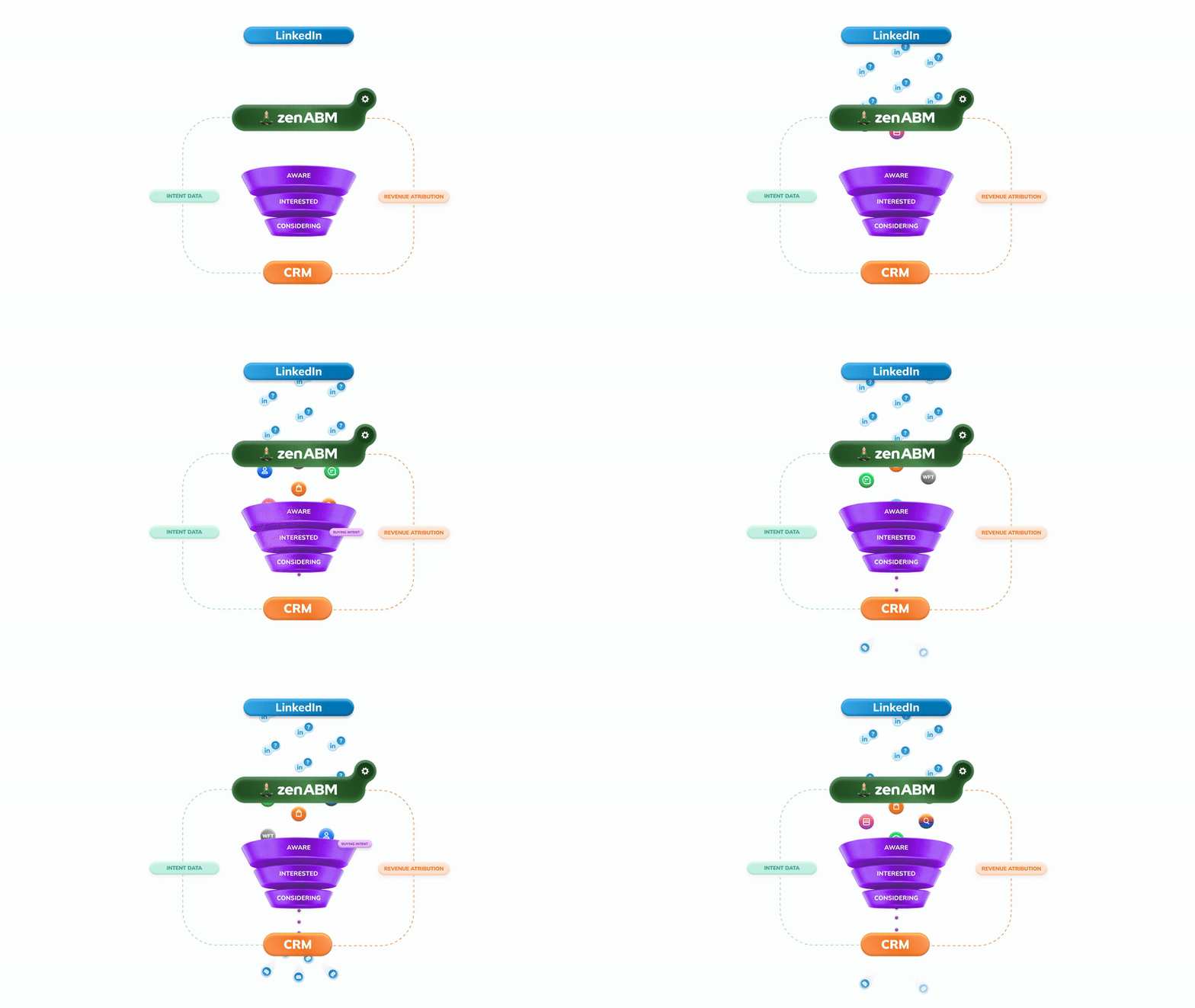
The key takeaway: successful ABM hinges on deep personalization, precise targeting, and alignment between marketing and sales. Tools like ZenABM further enhance these strategies with accurate attribution and CRM integration.
Now, it’s your turn. Choose tactics aligned with your B2B goals and drive impressive results
